Glimpse:
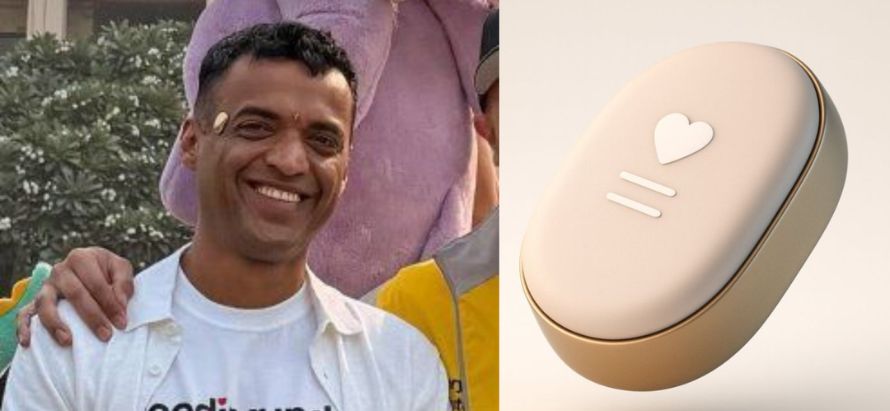
A small golden sensor worn near the temple region of the head, Temple is claimed to measure cerebral blood flow accurately and continuously. Goyal shared a first look on social media, stating that the device emerged from his research into the so-called Gravity Aging Hypothesis (GAH), which posits that gravity-induced reductions in brain perfusion may influence aging.
Though still experimental, Goyal says he’s used the device for over a year and believes brain flow is “already well accepted as a biomarker for ageing, longevity as well as cognition” implying the device could have broad health-monitoring relevance even if GAH doesn’t hold up.
On 7 December 2025, Goyal shared a brief teaser of a new device on Instagram with the caption “Getting there.” The small, gold-coloured sensor placed near his right temple immediately drew widespread attention and speculation across social media, with many wondering whether it marked a new foray into neurotechnology.
Goyal later explained on LinkedIn that the device, called Temple, is an experimental monitor designed to measure brain blood flow continuously and in real time. He said the tool is central to exploring the Gravity Aging Hypothesis, which suggests that long-term exposure to gravity may gradually reduce cerebral perfusion and contribute to neuro-ageing. The device, he noted, aims to generate the kind of longitudinal brain-flow data needed to test this idea.
He added that even if the Gravity Aging Hypothesis ultimately proves incorrect, continuous brain-flow tracking itself has significant value. Cerebral blood flow is already considered a potential biomarker of cognition, longevity, and ageing, making Temple a candidate for a future wearable focused on brain-health monitoring. According to Goyal, he and his team have been using an early prototype internally for about a year as part of ongoing research rather than a commercial rollout.
For now, however, technical details remain limited. Goyal has not disclosed what sensing technology Temple uses, how accurate its measurements are, or whether the device will ever be released publicly. He describes it as purely experimental, leaving open questions about its scientific validation, capabilities, and eventual real-world application.