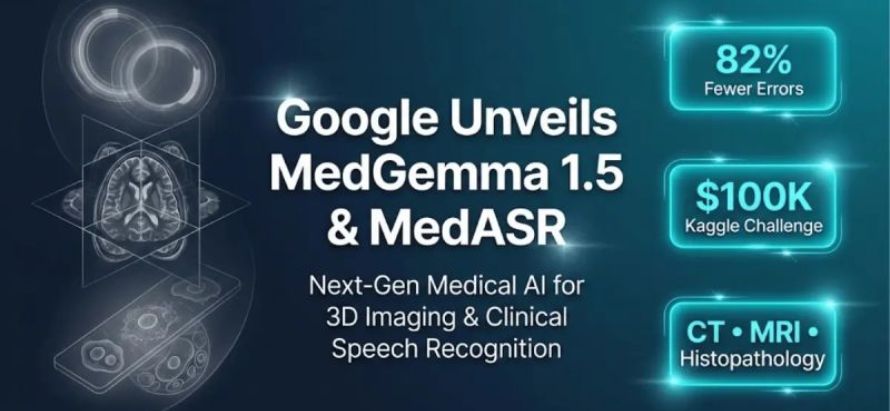
Google has significantly expanded its portfolio of specialised healthcare AI models with the release of MedGemma 1.5 and MedASR, announced on January 21, 2026. The new models build directly on the lightweight, open-weight Gemma family and are designed to empower developers, researchers, healthcare institutions, and technology partners to build advanced medical applications with greater speed and lower cost than proprietary closed systems.
MedGemma 1.5 is available in two core sizes 4 billion and 27 billion parameters and in both text-only and vision-language configurations. The vision-language variant can interpret medical images (X-rays, CT, MRI, pathology slides, dermatology photos) alongside clinical text, enabling tasks such as automated report generation, visual question answering, and multimodal clinical reasoning. Early benchmarks show MedGemma 1.5 matching or surpassing larger closed models on many medical evaluation sets, including MedQA, PubMedQA, SLAKE, PathVQA, and multimodal radiology challenges, while using far fewer parameters and compute resources.
MedASR, a dedicated 600-million-parameter automatic speech recognition model, has been optimised specifically for clinical dialogue. It handles medical terminology, abbreviations, acronyms, drug names, and noisy real-world environments (clinics, emergency rooms, telehealth calls) with significantly higher accuracy than general-purpose ASR models. The model supports English and is being fine-tuned for additional languages commonly used in global healthcare settings.
Both models are released under permissive open weights licences, allowing commercial use, fine-tuning, and derivative work creation. They are immediately available for download on Hugging Face and can be run on Google Cloud, local hardware, or through Google AI Studio for rapid experimentation. Google has also published detailed technical reports and evaluation results, including comparisons against closed-source medical LLMs, to support transparency and independent verification.
The launch reflects Google’s continued investment in open, developer-friendly medical AI tools following earlier releases such as Med-PaLM, Med-Gemini, and MedLM. By offering high-performing, lightweight models under open licences, Google aims to democratise access to advanced healthcare AI capabilities, particularly for academic researchers, startups, and institutions in resource-constrained settings.