The Ayushman Bharat Digital Mission (ABDM) has achieved remarkable scale over 420 million ABHA IDs issued and hundreds of thousands of facilities onboarded but implementation at the hospital level remains uneven and often challenging. Large corporate chains and urban tertiary centres have moved quickly toward compliance, but the majority of public hospitals, district facilities, and smaller private hospitals face persistent obstacles that hinder full realisation of the mission’s goals.
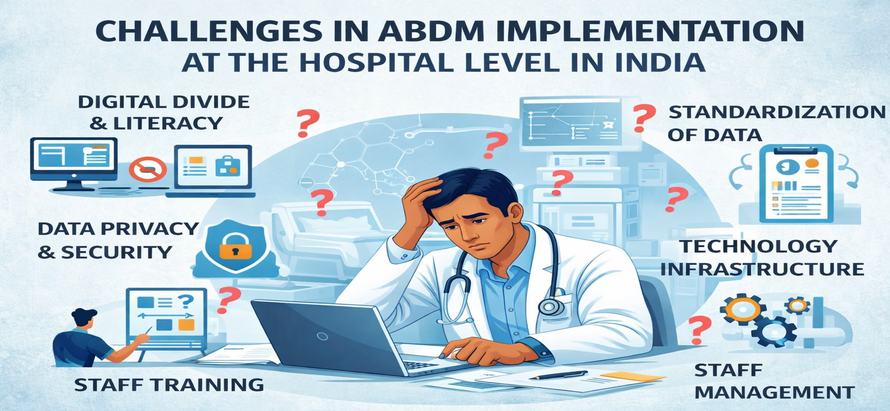
One of the most frequently cited barriers is technical integration with legacy systems. Many government and older private hospitals still rely on outdated or proprietary Hospital Information Systems (HIS) and Electronic Medical Records (EMR) that predate ABDM and lack FHIR-based interoperability. Retrofitting these systems to support ABHA linkage, consent management, and secure data exchange requires significant custom development, middleware solutions, or complete replacement investments that strain already limited budgets. In some cases, hospitals continue dual workflows (paper/digital) simply because full integration remains technically or financially unfeasible.
Staff resistance and inadequate change management compound the problem. Doctors, nurses, and administrative personnel often view ABDM-related tasks such as ABHA creation, consent recording, and digital documentation as additional administrative burden rather than clinical enablers. In high-volume OPDs, where physicians see 100–200 patients daily, even a few extra clicks per patient can feel overwhelming. Without adequate training, incentives, or demonstrated value (such as time savings from reduced paperwork), adoption remains superficial. Many frontline staff report feeling under equipped to explain ABHA benefits to patients or troubleshoot technical issues.
Infrastructure limitations remain acute, particularly in rural and semi-urban facilities. Unreliable electricity, poor internet connectivity, and lack of modern hardware (computers, tablets, scanners) make consistent digital workflows difficult. In many primary and community health centres, staff resort to paper records during outages or slow network periods, then attempt retrospective data entry leading to errors, delays, and incomplete records in the ABDM ecosystem.
Data quality and standardisation issues also persist. Inconsistent entry of diagnoses, procedures, and medications across facilities reduces the reliability of shared records. Without strong governance and training, digital records can become as fragmented and error-prone as paper ones were. Privacy concerns despite the safeguards of the Digital Personal Data Protection Act further slow adoption, with some doctors hesitant to digitise sensitive cases fearing liability or data misuse.
Resource constraints affect both public and smaller private hospitals. Training thousands of staff, procuring compatible hardware, and maintaining systems require ongoing investment that competes with clinical priorities. Many facilities lack dedicated IT teams or rely on overburdened district-level support, leading to slow issue resolution and user frustration.
Despite these challenges, progress is visible. Larger public hospitals and private chains with in-house IT capabilities have achieved high levels of ABDM compliance, reporting reduced duplicate testing, faster referrals, and better continuity for migrant patients. State-level initiatives in Bihar, Andhra Pradesh, and Uttar Pradesh have shown that focused training, incentives, and infrastructure upgrades can drive meaningful adoption even in resource-constrained settings.
The path forward requires sustained focus on change management, infrastructure support, simplified workflows, and clear demonstration of benefits to clinicians and patients. ABDM’s success ultimately depends on hospitals not just as participants, but as active champions of the digital ecosystem.