The Government of India has significantly scaled its AI-led maternal health research through the GARBH-INI programme, expanding it into a large-scale cohort study involving 12,000 pregnant women. Union Minister Dr. Jitendra Singh highlighted the project as a landmark effort to use artificial intelligence for early prediction and prevention of pregnancy complications, aiming to improve maternal and neonatal outcomes across the country.
Glimpse:
GARBH-INI (GARBH-Initiative for Research on Birth Outcomes) is collecting comprehensive multimodal data clinical, genomic, imaging, and lifestyle from 12,000 pregnant women across multiple centres. Advanced AI and machine learning models will analyse this rich dataset to identify risk patterns for conditions such as preterm birth, preeclampsia, gestational diabetes, and fetal growth restriction. The project is expected to generate India-specific predictive tools, support personalised antenatal care, and contribute to evidence-based policy making for maternal health.
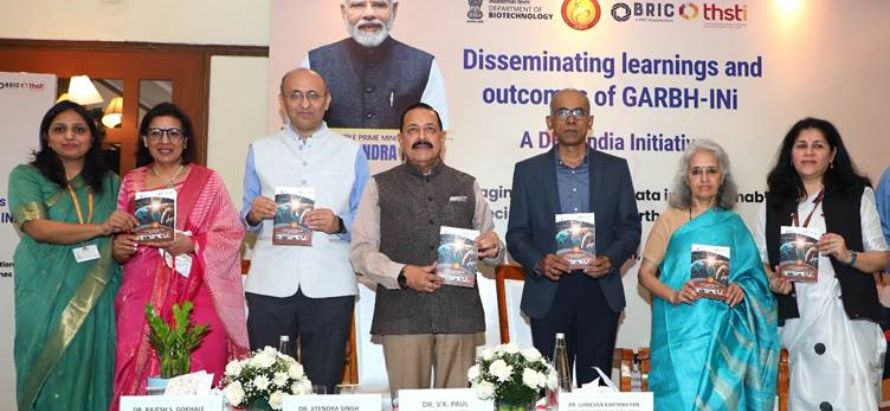
Union Minister of State (Independent Charge) for Science and Technology, Dr. Jitendra Singh, has announced a major expansion of India’s flagship maternal health research programme GARBH-INI, which will now track 12,000 pregnant women using advanced AI and data science techniques. The initiative, coordinated by the Translational Health Science and Technology Institute (THSTI) under the Department of Biotechnology, aims to create one of the largest and most detailed pregnancy cohorts in the world, specifically designed to address India’s unique maternal health challenges.
The GARBH-INI study collects extensive longitudinal data throughout pregnancy and the early postnatal period, including clinical parameters, genomic and proteomic profiles, ultrasound and other imaging data, nutritional status, environmental exposures, and socio-economic factors. Sophisticated AI and machine learning algorithms will be applied to this multimodal dataset to discover early predictive markers for common complications such as preterm labour, preeclampsia, gestational diabetes, intrauterine growth restriction, and postpartum haemorrhage. The goal is to develop simple, affordable risk prediction tools that can be used at primary care levels to enable timely interventions and significantly reduce maternal and neonatal morbidity and mortality.
Dr. Jitendra Singh described the project as a shining example of India’s “Atmanirbhar” approach in healthcare research using cutting-edge technology and large-scale Indian data to solve problems that are particularly relevant to the country. He noted that the findings from this 12,000-woman cohort will not only strengthen antenatal care protocols but also contribute valuable insights to global maternal health research. The study involves multiple clinical sites across different regions of India to ensure representation of diverse ethnic, socio-economic, and environmental backgrounds.
The expansion of GARBH-INI is supported by increased funding and collaboration between the Department of Biotechnology, Indian Council of Medical Research (ICMR), and leading academic institutions. Researchers expect the rich dataset and AI models to accelerate the development of personalised medicine approaches in obstetrics and to inform national policies under programmes like Surakshit Matritva Aashwasan (SUMAN) and Pradhan Mantri Surakshit Matritva Abhiyan.
This ambitious initiative underscores India’s growing leadership in applying artificial intelligence to public health challenges and its commitment to leveraging data science for improving maternal and child health outcomes on a national scale.