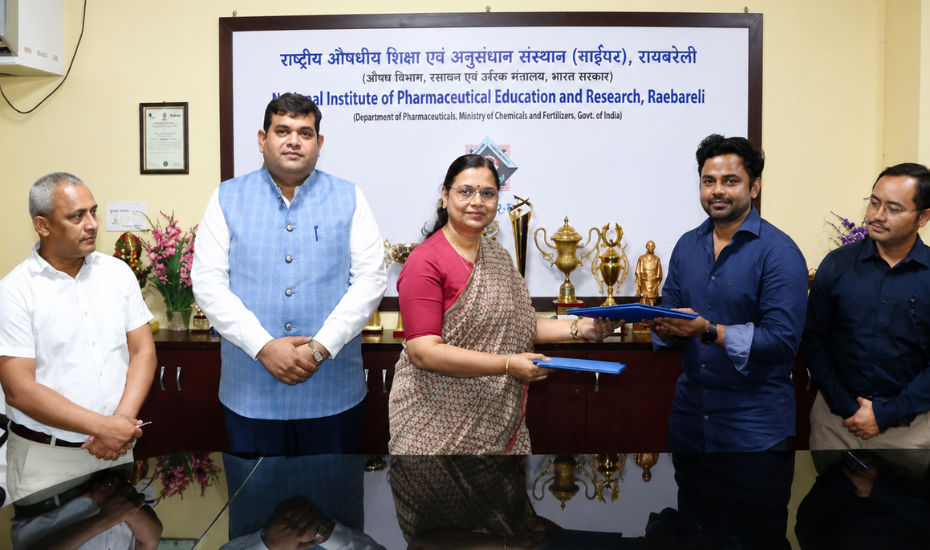
The National Institute of Pharmaceutical Education and Research (NIPER), Raebareli has signed a Memorandum of Understanding (MoU), Confidential Disclosure Agreement (CDA), and Technology Transfer Agreement with Hyderabad-based Lofty Laboratories to strengthen collaboration in pharmaceutical and biotechnology research. The partnership focuses on research innovation, technology commercialization, and industry driven scientific development.
According to multiple verified reports, the collaboration aims to bridge the gap between academic research and industrial application by jointly developing and commercialising technologies created at NIPER-Raebareli. As part of the agreement, Lofty Laboratories will adopt an industry ready technology developed at the institute for further development and large scale commercialization.
The technology was developed under NIPER’s Centre of Excellence on Novel Drug Delivery Systems (CoE-NDDS). Officials stated that the innovation particularly focuses on advanced gel-staining agents widely used in biological and molecular research, including studies related to genes, cancer, DNA/RNA analysis, and nucleic acid based diseases.
NIPER Director Prof. Shubhini A. Saraf stated that the partnership would help both institutions strengthen collaborative research activities and support future technology transfer initiatives. She also highlighted that several additional technologies developed at the Centre of Excellence may become ready for commercialization later this year.
Prof. Nihar Ranjan, Head of CoE-NDDS, explained that commercialisation of the indigenous gel-staining technology could significantly reduce the cost of important laboratory research materials currently dependent on imports. Experts believe this move could strengthen India’s biotechnology ecosystem, reduce research costs, and support the country’s “Atmanirbhar Bharat” innovation goals.
Industry analysts say the collaboration represents a growing trend of stronger academia-industry partnerships in India’s pharmaceutical sector, where research institutions are increasingly focusing on translating laboratory innovations into commercially viable healthcare technologies.