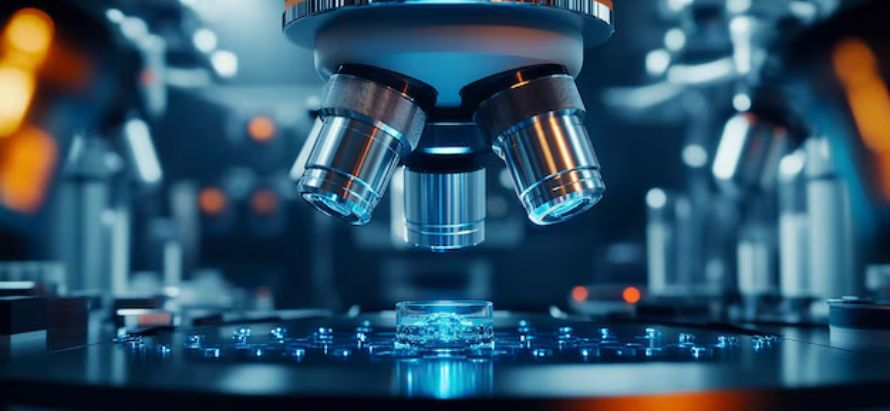
In a major milestone for Indian biomedical science, IIT Bombay has officially unveiled its Quantum Research Laboratories featuring the Quantum Diamond Microscope (QDM) and a first-of-its-kind liquid-helium cryogenic facility.
The QDM uses nitrogen-vacancy (NV) centers in diamond atomic-scale defects that retain quantum coherence even at room temperature enabling high-precision magnetic and nanoscale imaging in three dimensions. This makes it possible to observe cellular-level phenomena and structural changes within tissues with sensitivity far beyond conventional microscopy tools.
Paired with the cryogenic facility (using liquid helium to maintain extremely low temperatures), the setup supports advanced imaging including quantum-enabled confocal techniques and nanoscopic detection of biochemical signals like reactive oxygen species (ROS). In early experiments, researchers have successfully used the system to detect changes in human glioblastoma (a type of brain cancer) and keratinocyte cells, suggesting strong potential for early-stage cancer diagnostics.
Government officials say this initiative underlines India’s growing ambition under the National Quantum Mission: to build world-class quantum-enabled infrastructure in science, healthcare, materials, and computing. The facility will also support research in neuroscience, materials science, semiconductor diagnostics, and next-gen medical imaging making it a strategic asset for both health and technology sectors.