Researchers at Nanyang Technological University (NTU), Singapore, have developed an AI-powered biochip capable of detecting disease biomarkers within 20 minutes, significantly reducing diagnostic time and enabling faster clinical decisions.
Glimpse:
Announced in April 2026, the AI-enabled biochip uses a nanophotonic chip combined with AI-driven image analysis to detect microRNA biomarkers from a small blood sample. The system can identify multiple disease indicators simultaneously with high accuracy, reducing testing time from hours to just 20 minutes.
In a major breakthrough in rapid diagnostics, researchers at Nanyang Technological University (NTU), Singapore, have developed an artificial intelligence-powered biochip that can detect disease linked biomarkers in just 20 minutes. The innovation represents a significant advancement over traditional diagnostic methods, which typically take several hours to deliver results.
The biochip combines a nanophotonic sensing platform with AI-based image analysis. When a small drop of blood or saliva is placed on the chip, it can detect and measure multiple microRNA biomarkers tiny genetic molecules associated with diseases such as cancer, cardiovascular conditions, and neurodegenerative disorders.
Unlike conventional methods like PCR (polymerase chain reaction), which require amplification of genetic material and complex processing, the new system can analyze thousands of signals in a single snapshot. This significantly reduces both processing time and operational complexity while maintaining high sensitivity and accuracy.
A key innovation lies in the chip’s nanocavity structures, which amplify light signals from biomarkers, allowing detection of extremely low concentrations even down to a few molecules. These signals are then processed by AI algorithms to deliver rapid and precise results.
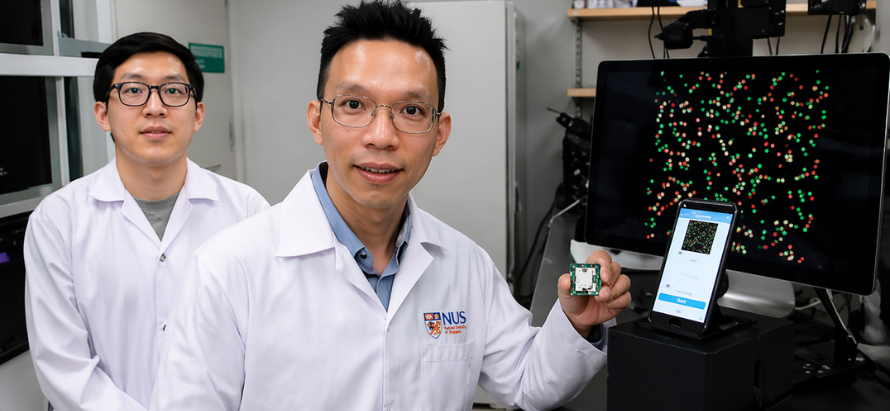
The researchers have also developed a compact prototype that integrates a camera and a mobile application. This allows the device to function as a portable diagnostic tool, potentially enabling point of care testing in clinics, remote areas, or even at home.
Early testing has shown promising results, including successful detection of biomarkers in lung cancer cells. The platform is designed to be adaptable, meaning it could be used to screen for a wide range of diseases by targeting different biomarkers.
Experts believe this innovation could play a key role in early disease detection, large scale screening, and personalized medicine, as it enables faster diagnosis and timely intervention. The technology is expected to move toward clinical trials and commercialization in the coming years.