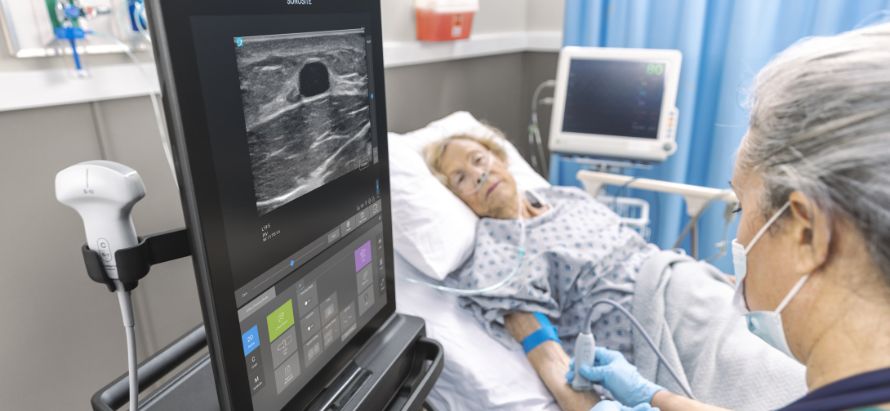
FUJIFILM Sonosite, a pioneer in point-of-care ultrasound (POCUS), has introduced PIV Assist, an AI-powered vascular-access feature built to support peripheral intravenous (PIV) procedures. Given how common peripheral IV insertions are and how challenging they can be in patients with difficult vascular access this tool aims to reduce cognitive load and improve clinician confidence.
The new system helps clinicians during the pre-scan phase by highlighting candidate veins, calculating the catheter-to-vein ratio (CVR) in real time, and showing the depth to the vein’s center.
Veins are color-coded according to the maximum recommended catheter gauge, and arteries are marked in red, aiding in procedural planning. This calculation is based on a large dataset the algorithm was trained using tens of thousands of scan images to enhance accuracy and reliability.
PIV Assist is licensed and available on Sonosite’s LX, PX, and ST ultrasound platforms, making it broadly accessible across point-of-care settings. According to FUJIFILM Sonosite’s leadership, the tool supports clinicians by streamlining vascular access planning, helping them make more informed decisions about vein selection and catheter size in real time.