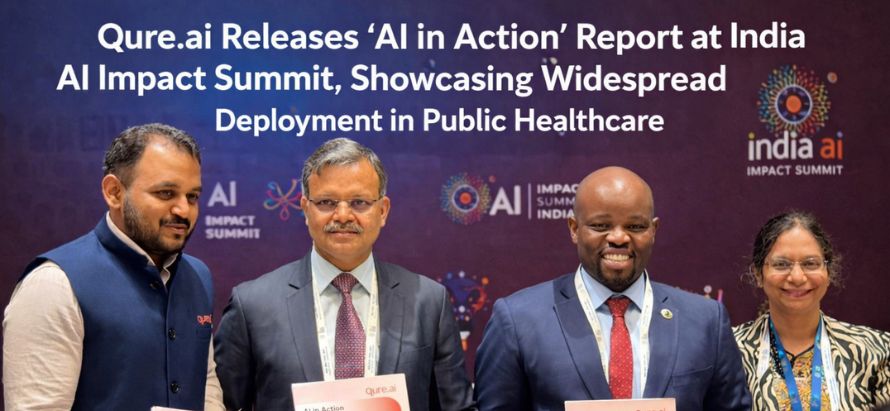
Qure.ai unveiled its ‘AI in Action’ report at the India AI Impact Summit, detailing the large-scale deployment of its AI tools across public healthcare facilities in India. The report highlights how chest X-ray AI (qXR), head CT stroke detection (qStroke), and other solutions are being used in government hospitals, district centres, and screening programs delivering faster triage, higher detection rates, and improved access in resource-constrained settings.
Glimpse:
The ‘AI in Action’ report documents Qure.ai’s real-world impact in public-sector radiology and emergency care. Key findings include millions of scans processed, significant reductions in reporting time, improved detection of TB, lung diseases, strokes, and head trauma, and successful integration into national programs like NTEP (National TB Elimination Programme) and Ayushman Bharat. The report underscores AI’s role in bridging radiologist shortages and enabling timely care in rural and semi-urban public hospitals.
At the India AI Impact Summit 2026, Qure.ai launched its comprehensive ‘AI in Action’ report, providing a detailed look at how its deep-learning solutions are transforming public healthcare delivery across India. The report aggregates deployment data, clinical outcomes, and operational metrics from hundreds of public-sector sites where Qure.ai tools are live.
Highlights from the report include:
qXR (Chest X-ray AI)Deployed in over 500+ public facilities under NTEP and general radiology workflows; processed millions of scans with high sensitivity for TB, pneumonia, lung nodules, and COVID-19 sequelae; reduced turnaround time from hours/days to minutes in many centres qStroke & qER (Head CT AI) Live in district hospitals and trauma centres; improved stroke window recognition and intracranial bleed detection, enabling faster referral and thrombolysis decisions Population-level screening programs Integration into large-scale chest X-ray screening drives, helping identify previously undetected cases in high-burden districts Radiologist augmentation AI acting as a second reader, reducing reporting burden and fatigue while maintaining or improving diagnostic accuracy
The report emphasizes that AI deployment has been particularly effective in public hospitals facing severe radiologist shortages often one radiologist serving multiple facilities. Qure.ai tools have helped prioritize urgent cases, reduced missed findings, and supported task-shifting to trained non-radiologist readers in remote areas.
Qure.ai stressed that all deployments follow strict validation protocols, clinician-in-the-loop workflows, and compliance with CDSCO, ABDM, and data privacy norms. The company also shared plans to expand into new use cases (mammography, orthopaedic X-rays, ultrasound) and deepen integration with public health platforms.
The launch of the report at the summit reinforces India’s growing narrative of responsible, scalable AI adoption in public healthcare, with Qure.ai positioned as a leading example of home-grown technology making measurable impact.