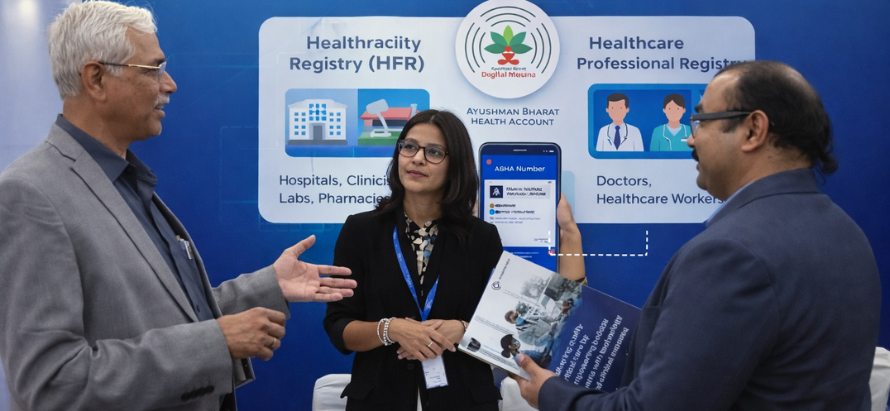
India’s Ayushman Bharat Digital Mission (ABDM) is built on a federated, privacy preserving architecture that relies on three core national registries to function effectively. At the centre of this design are the Health Facility Registry (HFR) and Health Professional Registry (HPR), which together establish trust, identity, and discoverability across the entire health system.
The Health Facility Registry (HFR) serves as the single source of truth for every health facility in the country public hospitals, private clinics, diagnostic labs, pharmacies, imaging centres, AYUSH centres, and wellness facilities. Each facility receives a unique HFR ID and digital credential, enabling patients, providers, and payers to instantly verify authenticity, location, services offered, operational status, and contact details. This eliminates confusion from duplicate or outdated listings and ensures that when a patient shares data or books a service, they are connecting with a legitimate, recognised entity.
The Health Professional Registry (HPR) performs the same role for individual healthcare providers. It integrates data from state medical, dental, nursing, pharmacy, physiotherapy, and paramedical councils to create a unified national directory. Every registered doctor, nurse, pharmacist, allied health professional, and community health worker receives a unique HPR ID and verifiable digital credential. This enables secure authentication during teleconsultations, e-prescriptions, and data sharing workflows, while also allowing patients and hospitals to confirm a practitioner’s qualifications and active registration status in real time.
Together, HFR and HPR provide the critical identity and trust layer for ABDM. When a patient creates an Ayushman Bharat Health Account (ABHA), links records, or consents to share data, the system uses HFR/HPR credentials to authenticate the requesting facility or professional. This ensures that only legitimate, registered entities can access or contribute to a patient’s digital health records preventing fraud, impersonation, or unauthorized access.
The registries are designed for high availability, scalability, and interoperability. They follow open standards (FHIR-based APIs), support real time updates from state councils and facilities, and allow consent-based data sharing without centralising sensitive personal health information. As of January 2026, HFR includes over 300,000 verified facilities, while HPR covers more than 1.2 million health professionals a scale that makes ABDM one of the largest digital health identity systems globally.
The practical impact is already visible. Patients can now verify hospital or doctor credentials before booking, e-prescriptions are trusted across state borders, teleconsultations are authenticated end to end, and public health programmes can map workforce distribution and facility readiness more accurately. These registries also enable future innovations such as automated credential verification for insurers, seamless referral pathways, and workforce analytics for planning.