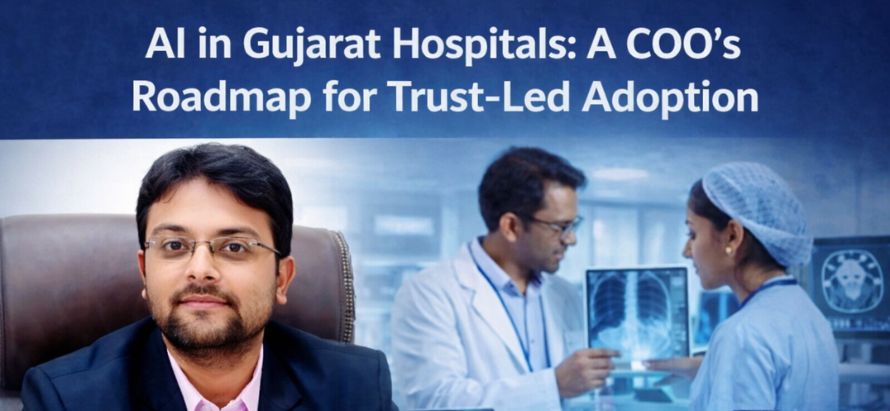
A senior COO from a leading Gujarat hospital chain shared a practical roadmap for building trust-led AI adoption at the facility level. The approach emphasizes clinician buy-in, transparent governance, phased pilots, continuous training, and measurable clinical impact ensuring AI tools are seen as supportive allies rather than disruptive threats in busy hospital settings.
Glimpse:
The COO outlined five key pillars for successful AI integration: early clinician involvement, clear ethical & data governance frameworks, small-scale trusted pilots, ongoing feedback loops & training, and tying AI success metrics directly to patient and clinician outcomes. This trust-first model has helped Gujarat hospitals move from skepticism to active usage of AI in radiology, triage, and workflow optimization reducing alert fatigue, improving adoption rates, and delivering safer, faster care.
During a panel discussion at a recent healthcare leadership forum in Ahmedabad, the Chief Operating Officer of a prominent multi-specialty hospital group in Gujarat presented a detailed, practitioner-oriented roadmap for introducing artificial intelligence in a way that earns genuine trust from doctors, nurses, and support staff.
The COO stressed that technology adoption fails most often not because of technical limitations, but due to lack of trust and perceived threat to clinical autonomy. Drawing from the hospital’s multi-year experience rolling out AI in chest X-ray reporting, emergency triage, and sepsis prediction, the executive outlined a repeatable five-step framework:
1. Clinician co-ownership from day one Involve senior consultants and department heads in tool selection, validation, and customization rather than imposing top-down decisions. 2. Transparent governance & explainability Establish hospital-level AI committees with clinical representation; mandate that every AI output includes reasoning, confidence scores, and source references (e.g., guideline citations). 3. Low-risk, high-visibility pilots Start with narrow, reversible use cases (e.g., “second reader” in radiology) where AI suggestions can be easily overruled and benefits are immediately visible to users. 4. Continuous training & feedback loops Run regular hands-on workshops, create “AI champions” within departments, and maintain open channels for reporting false positives/negatives treating clinicians as co-developers. 5. Outcome-linked success metrics Tie AI performance to clinical KPIs (reduced turnaround time, fewer missed findings, faster escalation of deteriorating patients) rather than just technical accuracy or usage volume.
The COO shared real-world results from Gujarat implementations: radiology AI adoption rose from ~35% to over 85% within 18 months after shifting to a trust-led model; alert fatigue dropped significantly once clinicians saw consistent value; and junior doctors reported feeling more confident in high-pressure settings due to AI guardrails.
The presentation resonated strongly with other hospital leaders present, many of whom are grappling with similar resistance while trying to meet growing expectations around digital health under ABDM and state innovation programs. The COO concluded that trust is not a soft factor it is the hardest and most critical infrastructure needed for sustainable AI adoption in Indian hospitals.