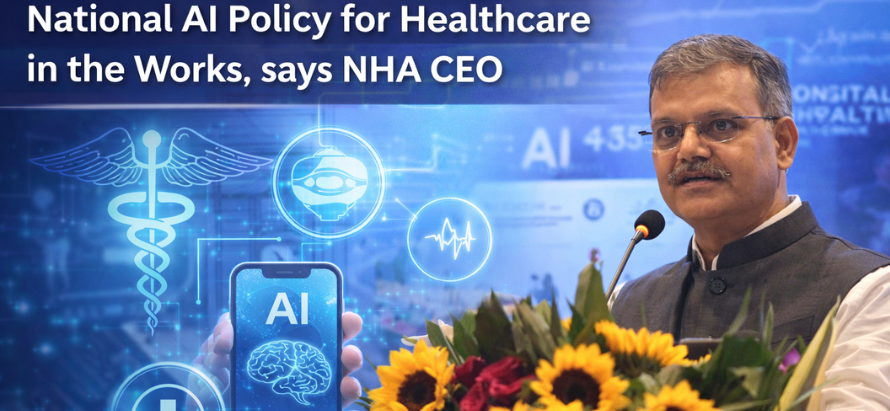
The CEO of the National Health Authority (NHA) has confirmed that the government is actively working on a dedicated national policy framework for the use of artificial intelligence in healthcare. The policy will address ethical deployment, data privacy, clinical safety, bias mitigation, and equitable access, aiming to guide responsible AI adoption across diagnostics, clinical decision support, remote monitoring, and public health programs under the Ayushman Bharat ecosystem.
Glimpse:
Speaking at a national healthtech summit on January 23, 2026, NHA CEO Dr. R.S. Sharma stated that the forthcoming AI policy for healthcare will set clear guidelines for developers, hospitals, and startups. It will cover risk-based classification of AI tools, mandatory validation on diverse Indian datasets, transparency requirements, accountability mechanisms, and integration standards with the Ayushman Bharat Digital Mission (ABDM). The policy is expected to be finalised and released in the coming months to foster innovation while safeguarding patient interests.
The National Health Authority (NHA) is preparing a comprehensive national policy on artificial intelligence in healthcare, according to Dr. R.S. Sharma, CEO of the NHA. The announcement was made during a keynote address at the India Digital Health Summit on January 23, 2026, where Dr. Sharma emphasised the need for structured governance as AI tools rapidly proliferate across diagnostics, treatment planning, remote monitoring, and public health initiatives.
Dr. Sharma noted that while AI offers tremendous potential to improve efficiency, accuracy, and access especially in a country with diverse population needs and resource constraints unregulated or poorly validated tools could lead to misdiagnosis, bias, privacy violations, and erosion of public trust. The upcoming policy is intended to provide a clear regulatory and ethical roadmap for all stakeholders, including technology developers, hospitals, diagnostic chains, startups, and government agencies.
Key elements expected in the national AI policy for healthcare include:
- Risk-based classification of AI tools (low, moderate, high) with corresponding regulatory requirements
- Mandatory clinical validation and performance testing on diverse Indian population datasets
- Requirements for transparency, explainability, and bias mitigation
- Strong data privacy and security standards aligned with the Digital Personal Data Protection Act
- Guidelines for integration with the Ayushman Bharat Digital Mission (ABDM) and existing EHR systems
- Mechanisms for post-market surveillance, adverse event reporting, and accountability
The NHA CEO stressed that the policy will balance innovation with patient safety, encouraging responsible development while preventing misuse. He highlighted that India’s unique demographic diversity makes it essential for AI systems to be tested and fine-tuned on representative local data rather than relying solely on foreign datasets.
The development of this policy is being coordinated with other ministries, including the Ministry of Electronics and Information Technology (MeitY) and the Department of Science and Technology, as well as regulatory bodies like CDSCO. Stakeholder consultations with clinicians, technologists, patient groups, and industry associations are already underway.