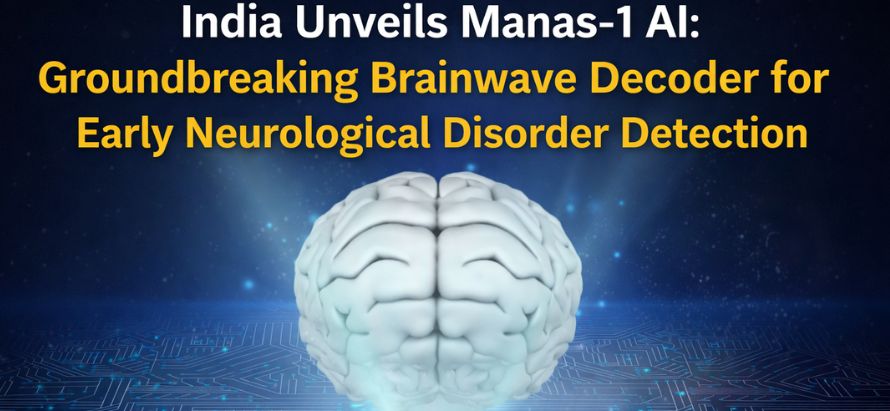
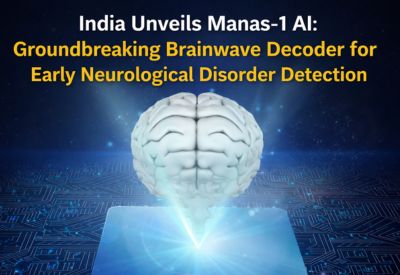
India has launched Manas-1, the country’s first indigenous AI model designed to decode brainwaves and enable early detection of neurological and psychiatric disorders. Developed under the national AI mission, the system analyzes EEG signals in real time to identify subtle patterns associated with epilepsy, Alzheimer’s, Parkinson’s, depression, autism spectrum disorder, and schizophrenia offering non-invasive, low-cost screening with high accuracy.
Glimpse:
Manas-1 uses advanced deep learning architectures trained on large-scale Indian EEG datasets to detect disorder-specific biomarkers with over 92% sensitivity in early validation studies. The portable, cloud-edge hybrid platform supports real-time analysis at primary care centres, telemedicine setups, and community screening camps. It is fully compliant with ABDM standards and DPDP Act privacy rules, and is already being piloted in select government hospitals and AIIMS centres with plans for nationwide rollout within 18–24 months.
The Government of India, through the Ministry of Electronics and Information Technology (MeitY) and in collaboration with leading research institutions including IIT Madras, AIIMS Delhi, NIMHANS Bengaluru, and the National Brain Research Centre, has officially unveiled Manas-1 India’s first sovereign AI model specifically engineered for decoding electroencephalogram (EEG) brainwave patterns to detect neurological and psychiatric disorders at the earliest stages.
Manas-1 was formally launched at the India AI Impact Summit 2026 by Union Minister Ashwini Vaishnaw in the presence of senior officials from ICMR, DBT, and NITI Aayog. The model represents a major milestone under the IndiaAI Mission and the National One Health Mission, addressing the massive underdiagnosis of brain-related conditions that affect over 150 million Indians, many of whom never reach specialized care due to lack of access, cost, or awareness.
The AI system processes multi-channel EEG signals using a combination of convolutional neural networks, transformers, and temporal attention mechanisms fine-tuned on one of the largest annotated Indian EEG datasets ever assembled (over 1.2 million minutes of clinical recordings from diverse age groups, regions, and socioeconomic backgrounds). It identifies micro-patterns and frequency-domain signatures invisible to the naked eye, enabling detection of epileptiform activity, early Alzheimer’s slowing, Parkinsonian tremor signatures, depression-related alpha asymmetry, autism spectrum connectivity abnormalities, and prodromal schizophrenia markers with reported sensitivity of 92–96% and specificity above 90% in independent validation cohorts.
The Manas-1 platform is designed for real-world deployment in low-resource settings. It operates in a hybrid edge-cloud mode: lightweight inference runs offline on portable EEG headsets or low-cost tablets at primary health centres, while complex cases are securely uploaded (with patient consent) to a sovereign cloud for deeper analysis and specialist review. The system generates instant risk scores, visual topographic brain maps, and plain-language reports in English, Hindi, and major regional languages, making results accessible to non-specialist doctors and community health workers.
Dr. Pravallika Mantravadi, lead neuroscientist at NIMHANS and one of the principal investigators, stated that the model has already shown superior performance compared to many international EEG AI tools when tested on Indian patient cohorts largely due to training on locally representative data that captures unique factors such as malnutrition-related encephalopathies, neurocysticercosis, and tropical infections that frequently mimic primary neurological disorders.
The Ministry has allocated initial funding for pilot deployment in 120 district hospitals and 500 primary health centres across 12 high-burden states, starting with Telangana, Karnataka, Uttar Pradesh, and Bihar. Integration with the Ayushman Bharat Digital Mission (ABDM) is complete, allowing EEG-derived insights to flow securely into patient ABHA records for longitudinal tracking and referral coordination.
Experts believe Manas-1 could dramatically shift the paradigm from late-stage treatment to early intervention in brain disorders, potentially reducing the national burden of disability-adjusted life years (DALYs) lost to neurological and psychiatric conditions by tens of millions over the next decade.