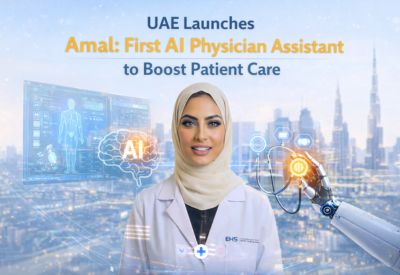
The United Arab Emirates has unveiled Amal, the country’s first AI-powered physician assistant designed to support doctors in delivering faster, more accurate patient care. Developed through a public-private collaboration, Amal integrates real-time clinical data, evidence-based guidelines, and multilingual capabilities to assist with differential diagnosis, treatment suggestions, and documentation while keeping final decisions firmly with human physicians.
Glimpse:
Amal acts as an intelligent co-pilot for clinicians, analyzing patient history, lab results, imaging, and current symptoms to generate differential diagnoses, flag risks, recommend next steps, and draft notes. Built with strong data privacy controls and trained on diverse regional datasets, it supports Arabic and English, reduces administrative burden, and enhances decision-making in busy UAE hospitals and clinics. The rollout begins in select facilities with plans for nationwide expansion.
The UAE Ministry of Health and Prevention (MoHAP), in partnership with leading technology and healthcare entities, has officially launched Amal the nation’s first AI physician assistant. Named after the Arabic word for “hope,” Amal is positioned as a supportive tool to augment not replace physicians, helping them manage high patient volumes while maintaining the highest standards of clinical judgment and empathy.
Key capabilities of Amal include: Real-time clinical reasoning Suggesting differential diagnoses and prioritizing based on likelihood and urgency Evidence-based recommendations Pulling from global and regional guidelines for investigations, treatments, and referrals Automated documentation Drafting structured notes, discharge summaries, and follow-up plans Risk flagging Early alerts for deterioration, drug interactions, allergies, or guideline deviations Multilingual support Seamless Arabic and English interaction, with plans for additional languages
Amal is deeply integrated with existing hospital information systems and UAE’s national health platforms, ensuring secure, consent-based access to patient data. It adheres to strict ethical AI principles, including transparency (clinicians see reasoning and sources), auditability, and human-in-the-loop oversight no automated orders or final diagnoses occur without physician approval.
The launch follows successful pilots in Abu Dhabi and Dubai hospitals, where Amal reportedly reduced documentation time by up to 40% and improved adherence to clinical protocols. The tool is now being scaled across public and private facilities under the UAE’s National Strategy for Artificial Intelligence in Healthcare.
This initiative reinforces the UAE’s ambition to become a global leader in AI-enabled healthcare, focusing on efficiency, quality, and patient-centered care in a rapidly growing population.