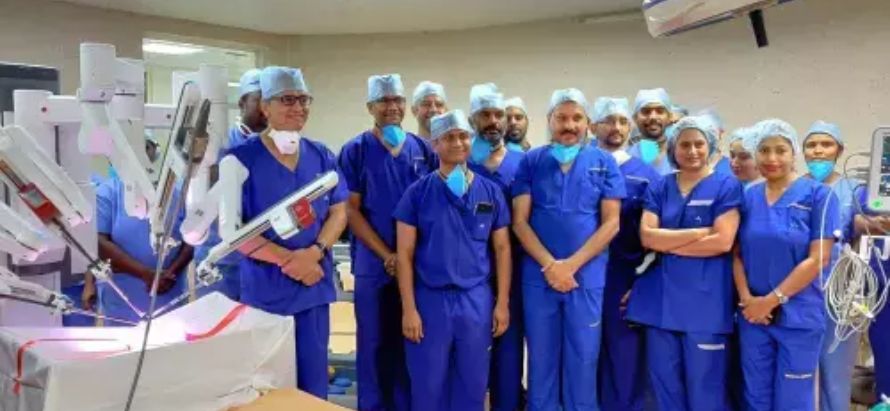
In October 2025, Narayana Health City in Bengaluru announced a pioneering feat in paediatric cardiac surgery: the successful robotic-assisted closure of a ventricular septal defect (VSD) in a child. This is believed to be the first such procedure in India.
The surgery was performed using miniature ports through the chest wall rather than opening the sternum, thereby reducing trauma. The robotic system provides the surgeon with high-definition 3D vision and wristed instruments capable of fine manoeuvres well suited to the small anatomical spaces in children’s hearts.
Following the VSD closure, the centre went on to perform a series of other congenital cardiac procedures robotically: atrial septal defect (ASD) closures, a repair of partial anomalous pulmonary venous connection (PAPVC) in conjunction with ASD, and a case of double-chambered right ventricle (DCRV) repair.
Dr Raghu M G, Senior Consultant of Cardiothoracic Surgery, remarked that “by combining robotic precision with minimally invasive techniques, we are able to treat congenital heart defects our young patients recover faster, with less discomfort and minimal scars”.
For patients, the benefits were significant: the children developed without needing blood transfusions, faced fewer complications, and were able to resume normal activity sooner. Such outcomes mark a major shift in how congenital cardiac conditions may be managed in India especially in paediatric settings where minimally invasive options have been limited.
Narayana Health City’s feat underscores the hospital’s commitment to advanced surgical innovation, especially in paediatric cardiac care and robotics. As robotic technology becomes more integrated, this could help address the burden of congenital heart disease with fewer disruptions and better long-term outcomes.