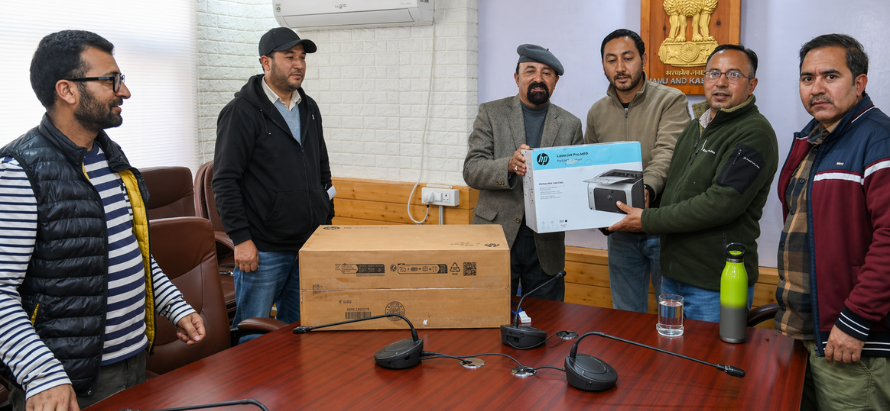
CEC Kargil has handed over IT infrastructure to healthcare facilities to accelerate the implementation of a Health Management Information System (HMIS), strengthening digital healthcare delivery in the region.
Glimpse:
Announced in April 2026, the Chief Executive Councillor (CEC) of Kargil facilitated the distribution of 16 IT equipment sets including computers, printers, and UPS systems to multiple healthcare centres. The initiative supports HMIS deployment to improve patient registration, reporting, and health data management across the district.
In a significant push toward digital healthcare transformation, the Chief Executive Councillor (CEC) of Kargil has overseen the handover of IT equipment to the Health Department to support the rollout of the Health Management Information System (HMIS) across the district.
The initiative includes the distribution of 16 sets of IT infrastructure, comprising desktop computers, printers, and uninterrupted power supply (UPS) systems. These have been allocated to key healthcare institutions such as PHCs, CHCs, and sub district hospitals including facilities in Trespone, Pashkum, Mulbek, Panikhar, Tambis, Drass, Sankoo, Padum, and Chiktan.
The deployment of this infrastructure is expected to streamline patient registration, reporting, and digital health record management, enabling healthcare providers to transition from manual processes to real time data entry systems.
By digitizing records and improving data accuracy, HMIS will help reduce administrative workload on healthcare staff while enhancing efficiency in service delivery. It will also support better planning, monitoring, and resource allocation at district and state levels through reliable health data insights.
Officials from the Health Department and National Health Mission highlighted that strengthening digital infrastructure is especially critical in remote and geographically challenging regions like Kargil, where access to healthcare services can be limited.
The initiative aligns with India’s broader push toward digital health systems, where HMIS plays a central role in enabling real time tracking of patient data, disease trends, and healthcare delivery performance.
As implementation progresses, the district is expected to see improvements in patient tracking, service efficiency, and overall healthcare outcomes, particularly benefiting underserved populations in remote areas.