Glimpse:
Led by Assistant Professor Sreetosh Goswami at the Centre for Nano Science and Engineering (CeNSE), the team synthesized 17 variants of molecular complexes to create thin films exhibiting diverse behaviors digital switching, analogue processing, memory storage, and synaptic plasticity. This adaptability addresses key challenges in neuromorphic hardware, where memory and computation are typically separated, enabling potential leaps in AI efficiency and brain-machine interfaces.
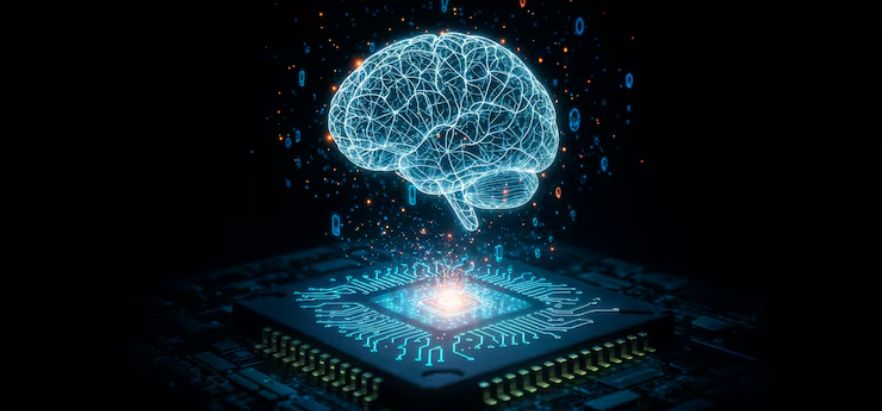
In a pioneering advance blending chemistry, physics, and engineering, scientists at the Indian Institute of Science (IISc) have developed molecular-scale electronic devices capable of mimicking core brain functions. These ruthenium-based molecular complexes form thin films that can switch functionalities based on electrical inputs, allowing a single device to serve as a memory element, logic gate, analogue processor, or even an artificial synapse that learns and forgets emulating synaptic plasticity in the human brain.
The breakthrough tackles a longstanding hurdle in neuromorphic computing: most materials rigidly separate memory and processing, unlike the brain’s integrated approach. By fine-tuning chemical ligands and surrounding ions, the IISc team created 17 molecular variants that control electron and ion movements, yielding behaviors from sharp digital states to smooth multi-level analogue responses.
Pallavi Gaur, a PhD student and first author, led device fabrication and testing, noting the system’s hidden versatility unlocked through chemistry. The research highlights how molecular design directly dictates computational outcomes, offering a pathway beyond silicon’s scaling limits.
While primarily aimed at ultra-efficient computing, the technology holds promise for healthcare applications brain-inspired accelerators could power advanced prosthetics, neural interfaces for neurological disorders, or AI-driven diagnostics mimicking cognitive processes.
This work builds on IISc’s leadership in brain-computation research, supported by initiatives like the Pratiksha Trust.