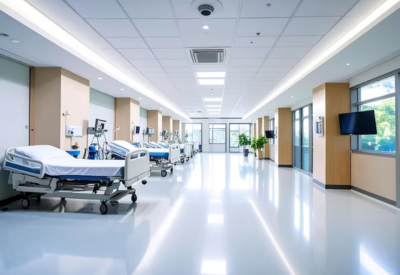
The Government of Maharashtra has announced a comprehensive 10-year roadmap to significantly expand hospital infrastructure, ICU beds, and critical care facilities across the state, with a deliberate focus on tier-2 and tier-3 cities, rural districts, and underserved regions outside the Mumbai-Thane-Pune-Nashik corridor. The initiative aims to address post-pandemic gaps in healthcare capacity, reduce patient transfers to metro cities, and improve access to emergency and specialised care for millions in smaller towns and villages.
Glimpse:
Unveiled on January 26, 2026, the plan targets an additional 25,000–30,000 hospital beds (including 8,000–10,000 ICU beds) by 2036, with phased investments in new district hospitals, medical colleges, trauma centres, and upgradation of existing taluka and rural hospitals. The state will leverage central schemes (PMSSY, NHM), PPP models, CSR contributions, and its own budget to achieve the goals. Phase 1 (2026–2029) prioritises 12 high-need districts with immediate infrastructure upgrades and new ICU installations.
The Maharashtra government has launched an ambitious decade long healthcare infrastructure roadmap aimed at dramatically increasing hospital beds, ICU capacity, and critical care access beyond the Mumbai-Pune metropolitan region. Chief Minister Eknath Shinde and Health Minister Tanaji Sawant formally outlined the plan on January 26, 2026, during a review meeting with senior officials, describing it as a “once in a generation” effort to rebalance healthcare delivery across the state.
The strategy responds to well documented post pandemic challenges: severe overcrowding in Mumbai and Pune hospitals during surges, long distance patient transfers from rural districts, and insufficient critical care beds in most non-metro areas. The government has set clear targets:
- Addition of 25,000–30,000 new hospital beds by 2036 (including 8,000–10,000 ICU/HDU beds)
- Establishment or upgradation of at least 15 new district hospitals and 25 sub-district hospitals
- Creation of 50–60 new trauma centres and emergency response hubs along major highways
- Expansion of medical college seats and teaching hospitals in underserved regions
- Significant augmentation of diagnostic, laboratory, and blood bank services in tier-2/3 facilities
Phase 1 (2026–2029) will concentrate on 12 high priority districts identified through gap analysis, including Gadchiroli, Nandurbar, Dhule, Beed, Osmanabad, Parbhani, Hingoli, Washim, Buldhana, Yavatmal, Gondia, and Chandrapur. These districts will receive immediate investments for new ICU wings, ventilator equipped beds, modular operation theatres, and advanced diagnostic equipment. Funding will come from a mix of state budget allocations, central schemes (PMSSY, NHM, PM-ABHIM), public-private partnerships, CSR contributions from major industries, and multilateral loans.
The plan also includes human resource development: recruitment and training of additional doctors, nurses, technicians, and critical care specialists, along with incentives for service in rural and tribal areas. The government has committed to integrating digital health tools (ABDM compliance, tele-ICU, e-OPD) in all new and upgraded facilities to ensure continuity of care and remote specialist support.
Chief Minister Eknath Shinde stated: “Mumbai and Pune cannot continue to bear the entire burden of critical care for Maharashtra. This decade long plan will bring world class hospital and ICU facilities closer to every family, especially in rural and tribal regions saving lives and reducing the hardship of long distance travel for treatment.”
Health Minister Tanaji Sawant added: “We are not just adding beds we are building a balanced, resilient healthcare system that can respond to routine needs as well as future pandemics or disasters. Every district and taluka will see tangible improvements over the next ten years.”
The announcement has been welcomed by public health experts and patient advocacy groups, who have long called for decentralisation of tertiary and critical care infrastructure. Implementation will be monitored through a dedicated task force with quarterly reviews and public dashboards tracking progress on bed additions, ICU commissioning, and staffing.