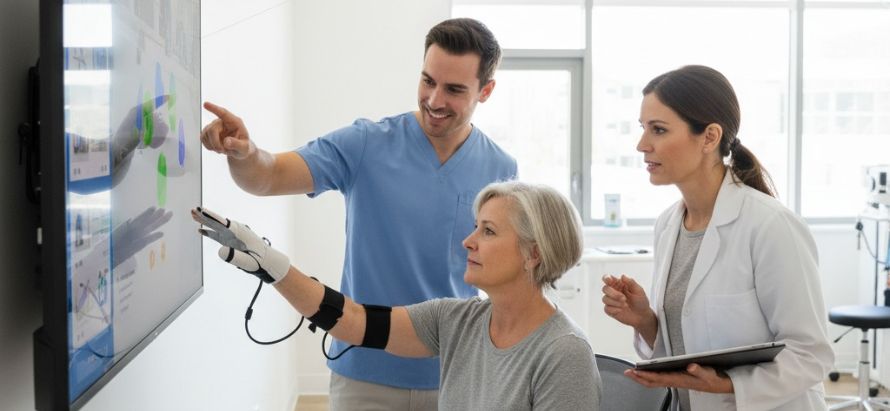
Stroke rehabilitation remains challenging, especially when patients face long-term motor or cognitive deficits. Experts now say that one promising game-changer is the use of interactive, game-based therapies especially virtual reality (VR) or augmented reality (AR) systems that complement traditional protocols. These platforms provide immersive, repetitive tasks with adjustable difficulty, real-time feedback and gamified motivation, which drive higher engagement and potentially better outcomes.
In India, neurorehabilitation centres report that games mimicking real-life activities such as moving objects, balancing, or reaching can activate neuroplasticity, the brain’s ability to reorganise neural pathways after injury. For example, in Bengaluru doctors at National Institute of Mental Health and Neuro Sciences (NIMHANS) say VR/AR games have helped patients recover mobility and coordination by engaging the unaffected brain hemispheres and boosting motivation
A clinical trial from the Manipal Academy of Higher Education found that stroke patients who used VR game therapy improved their upper‐limb motor abilities more than those who had only conventional neuro‐developmental training (difference of 3.47 points on the Fugl-Meyer Upper Extremity scale) after four weeks of treatment.
Why are these games effective? They deliver high‐repetition movements (essential for recovery), can be customised to patient ability, and keep the user engaged. According to rehabilitation research, fatigue and low motivation are key obstacles in post-stroke therapy; gamified systems succeed in overcoming these.
However, experts caution that such technologies are not a replacement for standard therapy: they work best in addition to physiotherapy, occupational therapy and under supervision. Also, long‐term evidence is still developing but early signals are encouraging.