Optum, a leading health services and technology company under UnitedHealth Group, has partnered with Microsoft to deploy advanced AI solutions that streamline and accelerate claims processing for payers, providers, and health systems. The collaboration integrates Microsoft’s Azure AI, Azure OpenAI Service, and Copilot capabilities with Optum’s deep RCM expertise to automate complex workflows, reduce denials, improve first-pass accuracy, and shorten payment cycles addressing one of the most persistent pain points in U.S. healthcare operations.
Glimpse:
Announced on January 27, 2026, the partnership will initially focus on AI-powered claims adjudication, denial prediction and prevention, automated appeals generation, and intelligent document processing for unstructured claims data. Early joint pilots have shown 30–50% reductions in manual review time, 15–25% lower denial rates, and faster reimbursement cycles. The solution is now available to select Optum clients, with broader rollout planned across the U.S. payer and provider markets throughout 2026.
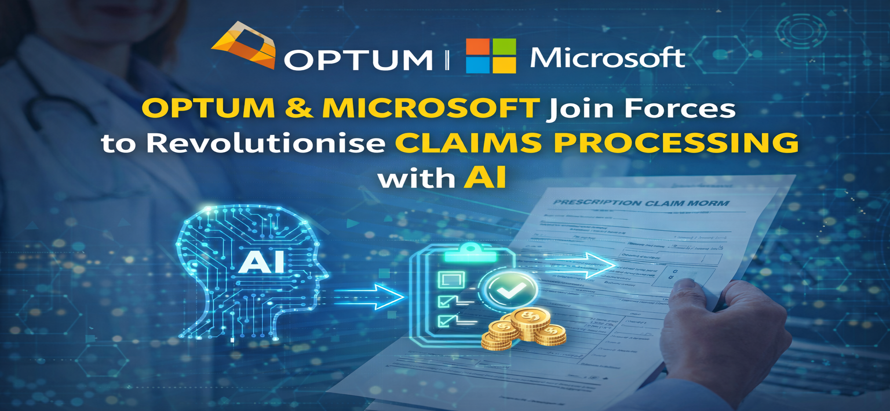
Optum and Microsoft have announced a strategic collaboration to transform healthcare claims processing through generative AI and cloud-scale automation. The partnership combines Optum’s extensive revenue cycle management (RCM) domain knowledge and vast claims dataset with Microsoft’s Azure AI platform, including Azure OpenAI Service and Microsoft 365 Copilot, to create intelligent tools that automate repetitive, error-prone tasks in the claims lifecycle.
The joint solution targets key pain points in claims processing:
- Automated claims scrubbing and adjudication — AI reviews incoming claims against payer rules, contracts, and medical necessity guidelines in real time, flagging issues before submission
- Denial prediction and prevention — Predictive models identify high-risk claims and recommend corrective actions (e.g., missing documentation, coding errors) prior to submission
- Intelligent appeals generation — Generative AI drafts compliant, evidence-based appeal letters tailored to specific denial reasons and payer policies
- Unstructured data extraction — AI processes scanned documents, PDFs, faxes, and handwritten notes to extract key data fields with high accuracy
- Real-time provider-payer collaboration — Copilot-powered tools assist staff in resolving complex claims through natural-language queries and automated follow-up workflows
The platform is built on Microsoft Azure with full HIPAA compliance, data encryption, audit logging, and role-based access controls. It integrates natively with major payer systems, provider EHRs, and RCM platforms (including Optum’s own tools), ensuring minimal disruption to existing workflows.
Early pilot results from select Optum payer and provider clients have shown significant gains: 30–50% reduction in manual review time, 15–25% decrease in initial denial rates, faster adjudication cycles, and improved first-pass resolution. The solution also reduces provider abrasion by minimising unnecessary back-and-forth with payers.
Optum leadership commented: “Claims processing remains one of the most inefficient and costly parts of healthcare. By combining our RCM expertise with Microsoft’s AI capabilities, we’re automating the routine while empowering teams to focus on complex cases ultimately accelerating payments and reducing friction for all stakeholders.”
Microsoft Health & Life Sciences Executive added: “Generative AI has the power to make administrative processes in healthcare faster, smarter, and less burdensome. This collaboration brings that potential directly to the claims workflow where speed and accuracy directly impact patient care and financial health.”
The partnership reflects the accelerating convergence of cloud AI platforms and specialised healthcare RCM expertise. The solution is now available to select Optum clients, with broader availability planned throughout 2026. Both companies have committed to ongoing innovation, including deeper integration with clinical systems, real time payer-provider collaboration tools, and expanded use of multimodal AI for claims attached documentation.