The Postgraduate Institute of Medical Education and Research (PGI), Chandigarh one of India’s most respected medical institutions has officially published its Digital Doctrine, a forward-looking policy document that places Hospital-at-Home (H@H) at the heart of its future service delivery model. This is believed to be the first time a top-tier government medical institute in India has formally embedded H@H as a strategic priority in institutional policy.
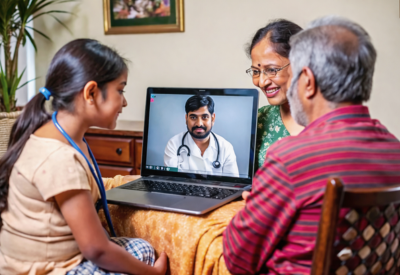
The doctrine recognizes that conventional hospital-centric models are increasingly strained by bed shortages, hospital-acquired infections, rising costs, and patient preference for home-based recovery. It defines Hospital-at-Home as “the provision of hospital-level care in the patient’s residence using integrated digital tools, remote monitoring, teleconsultations, and multidisciplinary teams.”
Key components of the PGI Digital Doctrine (H@H section):
Patient Selection Criteria Stable patients requiring monitoring, IV therapies, wound care, physiotherapy, or post-acute rehabilitation (e.g., post-orthopaedic surgery, COPD exacerbation, heart failure, post-chemotherapy recovery).
Technology Stack Integration with ABDM/ABHA for record portability, continuous vital sign monitoring (wearables + gateways), AI-based deterioration prediction algorithms, daily video rounds, and 24/7 tele-ICU support.
Clinical Governance Dedicated H@H multidisciplinary teams (physicians, nurses, physiotherapists, pharmacists), daily virtual ward rounds, escalation protocols, and clear discharge/re-admission criteria.
Pilot Roadmap Initial rollout in select departments (Geriatrics, Pulmonology, Cardiology, Orthopaedics) in 2026, with measurable KPIs: readmission rates, patient satisfaction, cost per episode, and bed-days saved.
Prof. Vivek Lal, Director, PGI Chandigarh, stated during the doctrine release: “The future of high-quality tertiary care cannot be confined within four walls. Hospital-at-Home, powered by digital tools and AI, allows us to safely extend our expertise into the patient’s home where healing is often faster and more dignified.”
The doctrine also addresses equity: special focus on patients from rural Himachal, Punjab, Haryana, and J&K who currently travel long distances for follow-up care.
This policy move is expected to influence other AIIMS and top medical colleges, accelerating the national conversation on scaling H@H under Ayushman Bharat and ABDM frameworks.