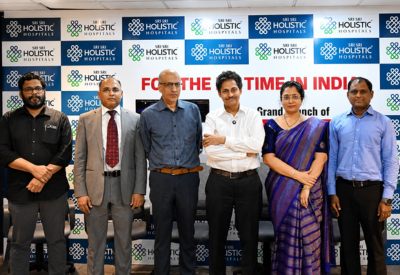
Day 1 of the AI Impact Summit 2026 in New Delhi established a clear national and global agenda for responsible, inclusive, and trustworthy AI deployment in healthcare. High-profile sessions featuring policymakers, clinicians, technologists, and ethicists emphasized patient safety, data privacy, bias mitigation, clinician trust, and equitable access as non-negotiable foundations for scaling AI solutions across India’s public and private health systems.
Glimpse:
The opening day featured keynote addresses, expert panels, and launch announcements centered on ethical AI frameworks, real-world governance models, clinician-led adoption strategies, and India-specific safeguards. Key messages included the need for transparency, continuous validation, human-in-the-loop oversight, and alignment with ABDM/DPDP standards. The day successfully framed responsible AI not as a constraint, but as the prerequisite for sustainable, high-impact transformation in Indian healthcare.
The inaugural day of the AI Impact Summit 2026 successfully set a mature, principle-driven tone for the future of artificial intelligence in Indian healthcare. Held in New Delhi, the summit brought together health ministers, senior bureaucrats, leading hospital administrators, AI researchers, startup founders, ethicists, and international experts to deliberate on how to responsibly harness AI’s potential while protecting patients, clinicians, and public trust.
Responsible AI as a clinical safety imperative Multiple speakers stressed that AI in healthcare must be held to higher standards than in other sectors because errors can directly affect life and death. Clinician trust & involvement Repeated emphasis on co-design with doctors, transparent explainability, and avoiding “black-box” models that erode confidence. Data privacy & security Strong alignment on DPDP Act 2023 compliance, anonymization protocols, consent management via ABDM Consent Manager, and robust audit trails. Bias & equity safeguards Discussions on India-specific model training (diverse demographics, regional languages, rural-urban differences) to prevent algorithmic discrimination. Governance & validation frameworks Calls for national AI-in-health guidelines, mandatory third-party clinical validation, post-market surveillance, and clear escalation paths when AI errs. Real-world deployment lessons Case studies from early AI adopters (radiology, TB screening, sepsis prediction) showed that trust-led, phased rollouts yield higher adoption and better outcomes than top-down mandates.
Several important announcements reinforced the day’s responsible AI focus: Release of updated ethical AI guidelines for healthcare by a multi-stakeholder task force Launch of public-sector AI validation sandbox under ICMR/NITI Aayog collaboration Commitment to clinician AI literacy programs across medical colleges and hospitals
The opening day successfully moved the conversation beyond hype toward pragmatic, patient-first governance setting expectations that AI will be judged not only by accuracy metrics, but by how safely, fairly, and transparently it serves India’s 1.4 billion people.