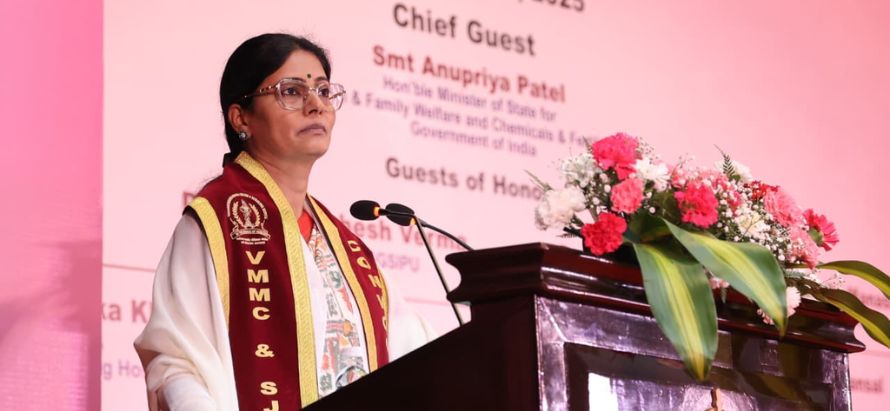
India’s public healthcare landscape has undergone a profound transformation over the last 11 years, with significant strides in infrastructure, medical education, affordability, and digital health integration, Union Minister of State for Health and Family Welfare Anupriya Patel declared while addressing the 7th annual convocation ceremony of Vardhman Mahavir Medical College & Safdarjung Hospital in New Delhi on December 22, 2025.
The minister underscored that digital health has emerged as a pivotal force in advancing universal healthcare, placing India at the global forefront of innovative technologies. She attributed this progress to the government’s holistic approach in rebuilding the entire healthcare pyramid from primary to tertiary levels while embracing digital solutions to enhance accessibility, efficiency, and outcomes.
Key highlights from Patel’s address include the operationalization of more than 1.82 lakh Ayushman Arogya Mandirs nationwide, delivering comprehensive primary care services to millions. The government is actively addressing gaps in secondary healthcare through upgrades to Community Health Centres (CHCs) and district hospitals, while expanding tertiary care networks and reimagining medical education to produce skilled professionals aligned with modern needs.
Affordability remains a cornerstone, with schemes like Pradhan Mantri Jan Aushadhi Pariyojana and Amrit Pharmacies providing essential medicines, medical devices, and surgical implants at significantly discounted rates. These initiatives complement the digital health push, ensuring that technological advancements translate into tangible benefits for all citizens.
Patel congratulated graduating medical professionals, urging them to uphold ethical standards, compassion, and dedication while contributing to India’s evolving healthcare ecosystem. She emphasized that public medical institutions play a central role in this transformation, fostering a more inclusive and resilient system.
This vision aligns with broader national efforts under the Ayushman Bharat framework, including the Ayushman Bharat Digital Mission (ABDM), which continues to drive the creation of Ayushman Bharat Health Accounts (ABHA), electronic health records, and interoperable digital infrastructure. The minister’s remarks reflect the government’s commitment to leveraging digital tools for seamless, patient-centric care amid rapid healthcare modernization.
With sustained focus on infrastructure expansion, capacity building, insurance coverage, and digital innovation, India is steadily progressing toward its goal of universal health coverage.