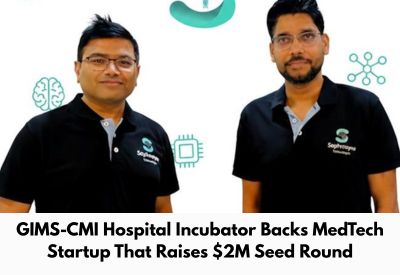
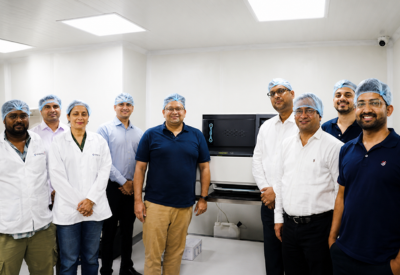
In a landmark achievement for public-hospital innovation in India, a startup nurtured within the Centre for Medical Innovation (CMI) at GIMS, Greater Noida, has secured $2 million in seed funding. This marks the first time a startup from a government hospital based incubator has raised such a significant amount, showcasing the rising potential of MedTech innovation rooted in real-world clinical environments.
The funding round was led by Bluehill.VC, and supported by a Design-Linked Incentive (DLI) grant from the Government of India reflecting strong institutional confidence in the startup’s vision. The startup, named Sophrosyne Technologies, is focused on building ultra-low-power, medical-grade chipsets designed specifically for Indian healthcare needs with multi-vital biosensing, intelligent energy management, and AI-based real-time risk prediction.
Sophrosyne’s product roadmap includes next-generation wearables and medical devices that could operate more efficiently, and potentially harvest energy, reducing reliance on foreign chipsets. According to its founders, the richly supportive environment at GIMS has been critical: they benefit from clinical immersion, device validation, and regulatory mentoring directly within a functioning public hospital.
For CMI-GIMS, this milestone is more than a win for the startup it’s a validation of their pioneering public hospital based incubation ecosystem. With this success, GIMS CMI is positioning itself as a replicable national model for med-tech innovation rooted in public healthcare systems.